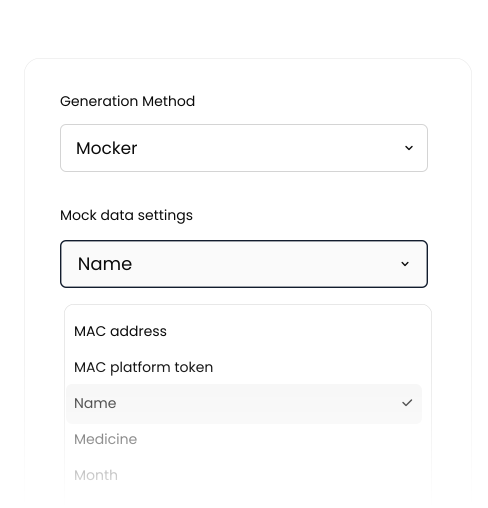
Key benefits of using synthetic data
No PII and PHI data in the dataset
Organizations need easy-to-use and practical tools to exclude PII or PHI from their datasets to protect individual privacy and comply with data protection regulations. It helps to mitigate the risk of data breaches and ensure compliance with legal standards.
Representative data replacement
Synthetic data accurately reflects the characteristics of real data. It allows organizations to replace data with representative alternatives in minutes.
Complex data creation from scratch
Advanced data creation with rule-based synthetic data accurately simulates real-world scenarios. Enable the creation of highly realistic datasets from scratch, incorporating complex logic, relationships, and dependencies.
User documentation
Explore the Omni user documentation
Why Omni's generators are more advanced
Omni supports 150+ different generators
Omni supports default generators such as first name, last name, social security, and phone number generators, ensuring comprehensive and customizable data creation for diverse needs.
Multilanguage support
Omni supports each generator in over 80 languages and different alphabets. We are supporting a diverse range of linguistic and regional needs.
Rule-based synthetic data
Rule-based synthetic data allows users to generate data based on predefined rules & logic or based on other columns in your database. Various formulas can be used to perform a wide range of operations on data, from simple arithmetic to complex logical and statistical computations. This ensures that the data adheres to specific patterns and constraints and allows for the creation of highly accurate and contextually relevant data.
Advanced generators
Advanced generators are configurable generators that enable users to fine-tune data according to their specific needs. Examples include the custom text generator, which generates customizable strings containing letters, numbers, and symbols, and the Uniform Distribution Generator, which allows users to set minimum, maximum, and precision to generate numerical values that follow a specific distribution.
Synthetic Data
Synthetic Data in 3 steps
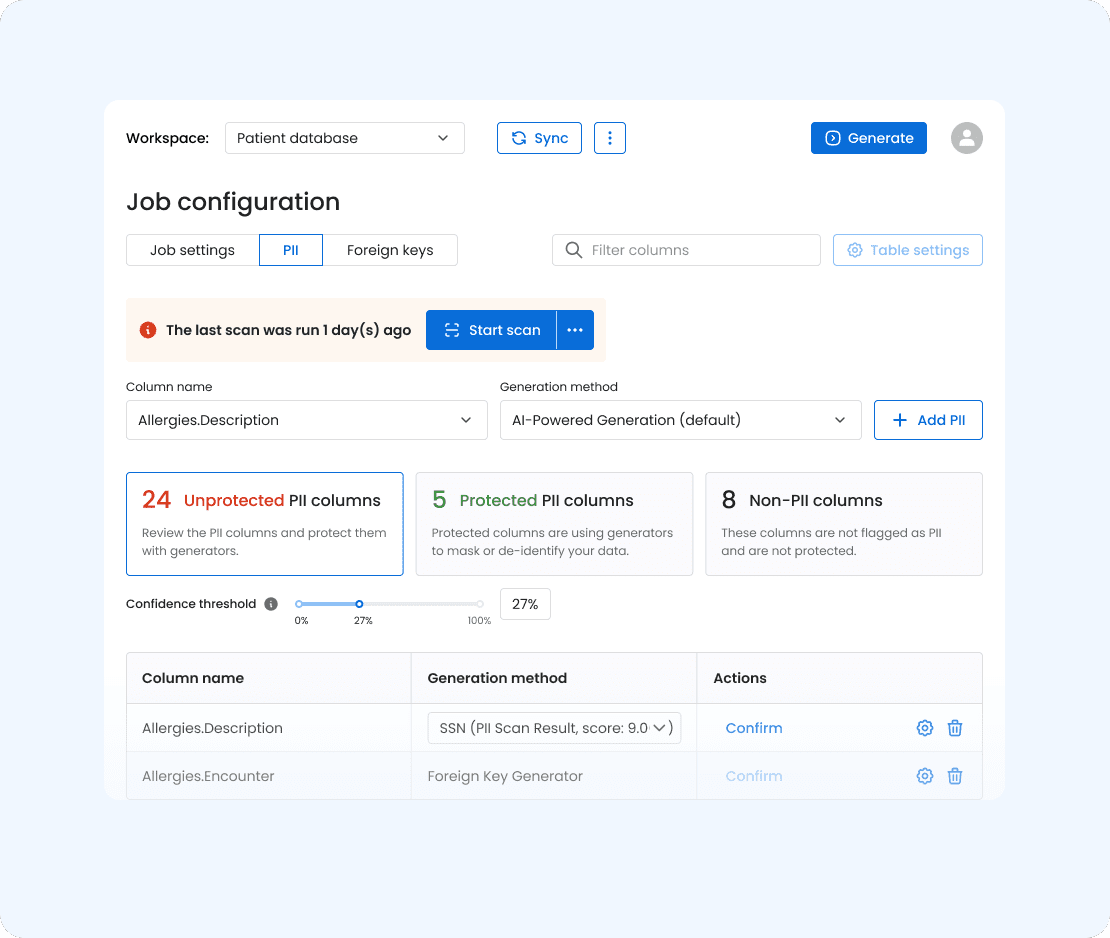
Identify PII
Scan PII automatically with our PII Scanner via the "PII" tab or identify columns that you would like to generate via the "Job Configuration" tab.
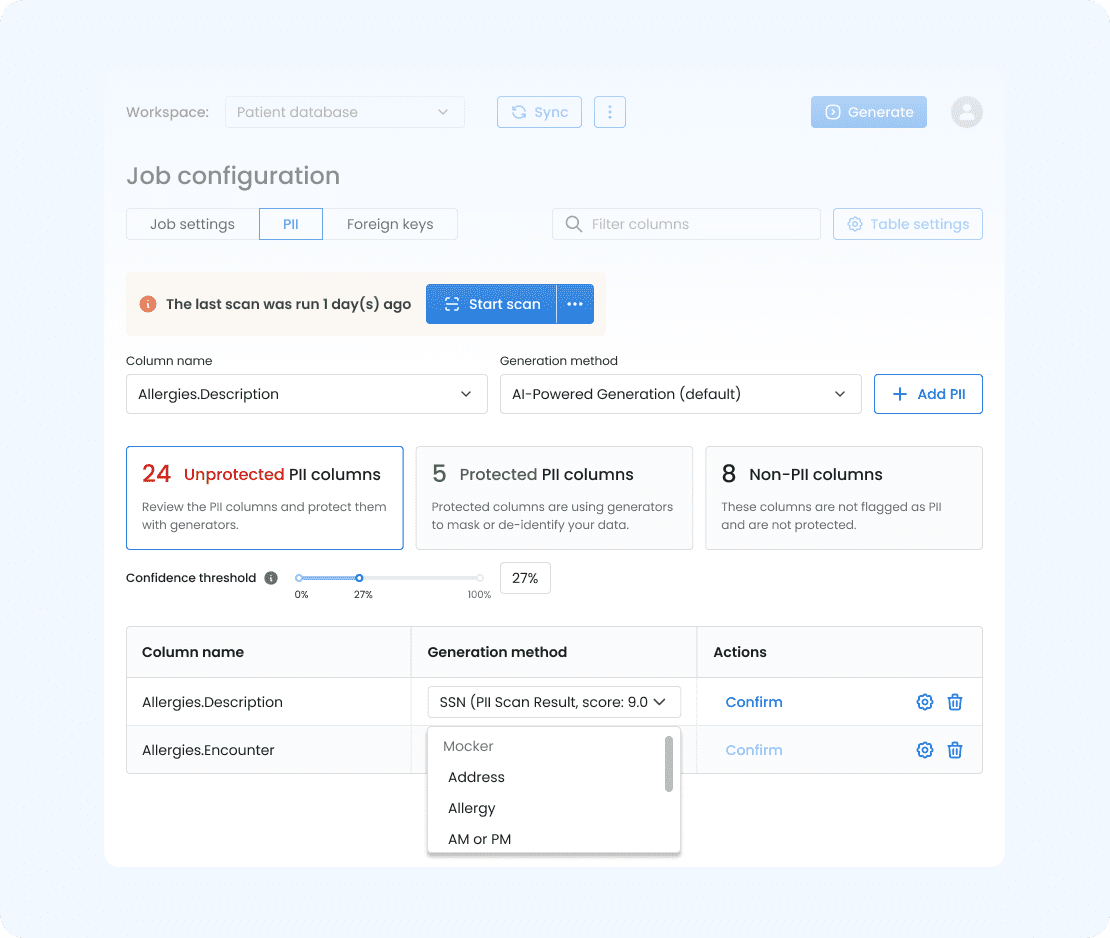
Select Generators
Confirm the by our PII scanner suggested generator automatically or configure generators on column level.
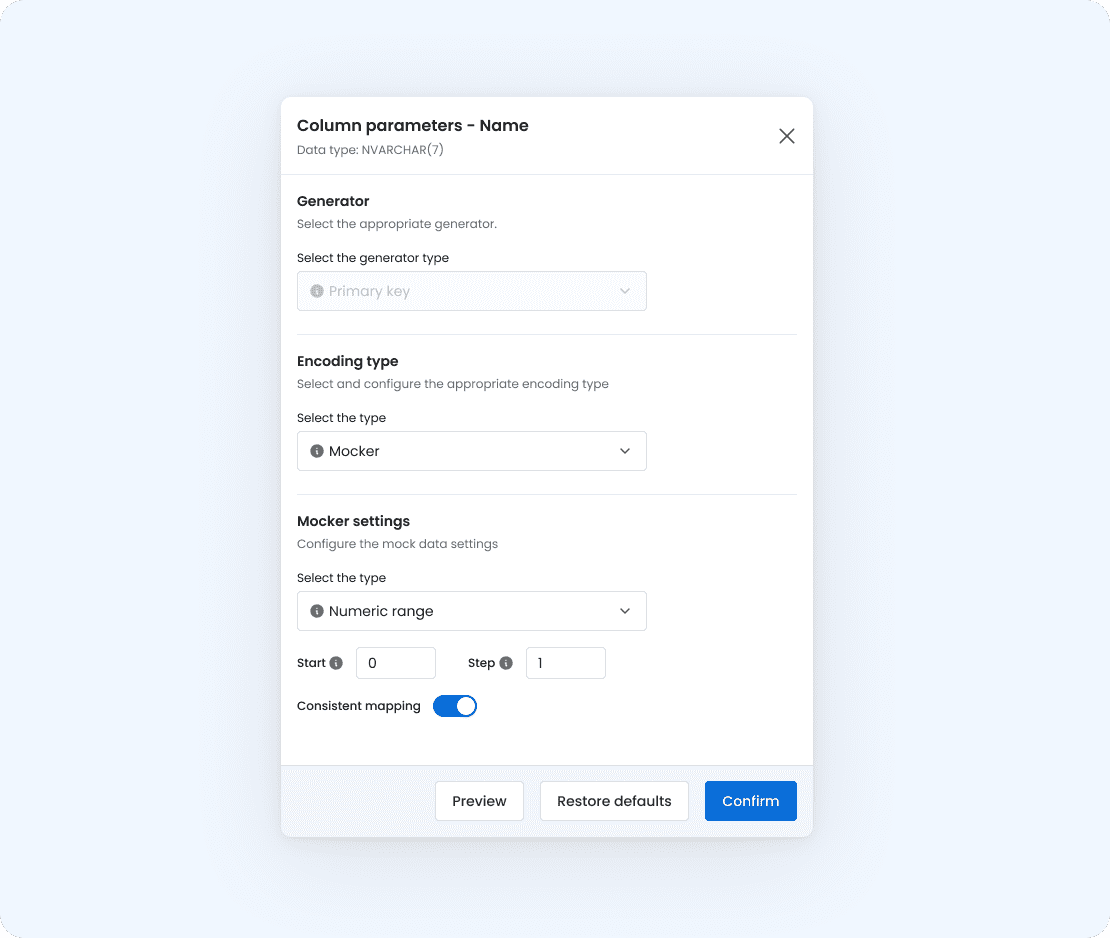
Confirm Generator
Confirm to apply the selected generator to a column via the PII or Job Configuration tab. This allows users the flexibility to spot columns and apply generators accordingly.
Other features from Omni
Data Masking
PII Scanner
Identify PII automatically with our AI-powered PII Scanner.
Synthetic Data
Simulate Real-World Scenarios.
Consistent Mapping
Preserve referential integrity in an entire relational data ecosystem.
Rule-Based Synthetic Data
Formula-Based Synthetic Data
Generate Synthetic Data according to defined formulas
Pattern-Based Synthetic Data
Generate Synthetic Data according to patterns
Subsetting
Increase the number of data samples in a dataset.
AI Generated Synthetic Data
Quality Assurance Report
Assess generated synthetic data on accuracy, privacy, and speed.
Time Series Synthetic Data
Synthesize time-series data accurately with Omni.
Upsampling
Create Manageable Date Subsets.
Frequently Asked Questions
Substitute sensitive PII, PHI, and other identifiers with representative Synthetic Data that follow business logic and patterns.
PII (Personally Identifiable Information) includes data like names, addresses, and social security numbers. PHI (Protected Health Information) refers to health-related data. Identifiers are any data points that can be used to identify an individual.
Examples include names, email addresses, phone numbers, social security numbers, medical records, insurance IDs, IP addresses, and biometric data.
Organizations use generators to protect sensitive data while maintaining data utility for testing, development, and analytics purposes. This ensures compliance with privacy regulations while enabling teams to work with realistic data.
Real data problematic?
Turn to synthetic data!
Explore with us how to create data that mimics real data,
safely and efficiently, using synthetic data